Why Higher Order Modulation is less Noise‑Resistant?
BPSK and QPSK are fundamental digital modulation schemes known for their robustness to noise. Higher-order modulations, such as 16QAM, 64QAM, 256QAM offer higher data rates but are more sensitive to channel conditions. This article explores the trade-offs between noise resistance and spectral efficiency.
Digital modulation enables reliable data transmission over wireless channels. Among the most widely used modulation schemes, BPSK (Binary Phase Shift Keying) and QPSK (Quadrature Phase Shift Keying) are known for their robustness to noise, while higher-order schemes like 16QAM and 64QAM offer higher data rates but are more sensitive to channel impairments.
Why Lower Order Modulations are Noise-Resistant
BPSK represents one bit per symbol with two constellation points separated by 180°, while QPSK represents two bits per symbol with four points separated by 90°. The large separation between constellation points makes it easy for the receiver to distinguish between symbols even in the presence of noise.
This is why BPSK is often used for critical signals like PSS in 5G systems, and QPSK is used for control or moderate-data signals. Their robustness ensures low bit error rates at low signal-to-noise ratios (SNR), ensuring reliable communication.
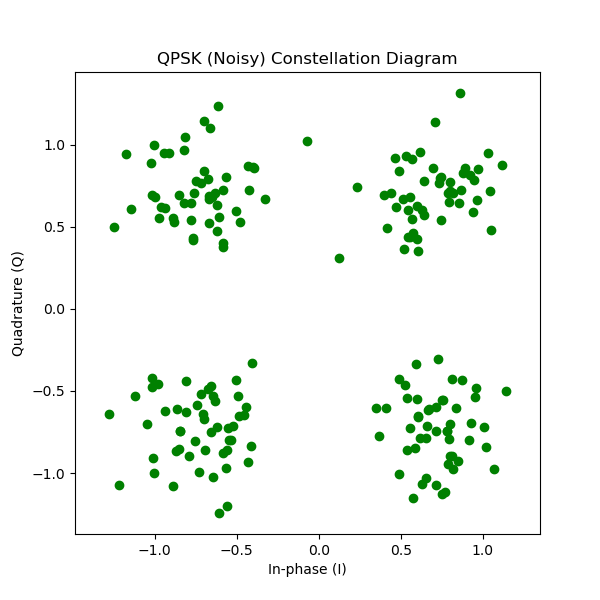
Figure 1: QPSK Constellation Diagram. Notice the wide spacing between points, which allows detection even with noise.
Higher-Order Modulations - Trade-Off between Data Rate and Robustness
Higher-order modulation schemes, such as 16QAM or 64QAM, increase the number of bits per symbol, allowing higher data rates and better spectral efficiency. However, this comes at a cost: the distance between constellation points decreases, making the signal more sensitive to noise and phase errors.
In practical systems, this means that while 16QAM can transmit four times more bits per symbol than BPSK, it requires higher SNR to maintain reliable communication. Without proper error correction and channel management, noise can easily cause symbol errors, leading to corrupted data.
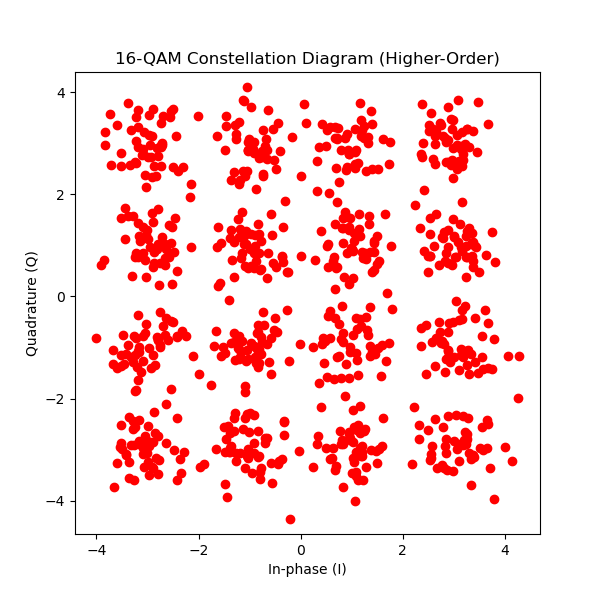
Figure 2: 16QAM Constellation Diagram. The points are closer together, making them more sensitive to noise.
Key Takeaways
- BPSK/QPSK: Ideal for low-SNR channels, synchronization signals, and moderate data rates. Robust due to large symbol separation.
- Higher-order modulation (16QAM/64QAM): Suitable for high-data-rate transmissions but requires higher SNR and error correction techniques.
- Trade-off: Choosing the right modulation depends on channel conditions, required data rate, and system design.
In this article, Why Higher Order Modulation needs high SNR?, we will see why higher SNR is needed for Higher-order modulations.