Why Higher Order Modulation needs High SNR?
Higher-order modulation schemes like 16QAM or 64QAM achieve high data rates but are sensitive to noise. At high SNR, the distance between constellation points is sufficient for accurate symbol detection, reducing errors and enabling reliable communication.
The key factor that makes higher-order modulations feasible is a high signal-to-noise ratio (SNR). When SNR is high, the signal power dominates the noise, keeping the received constellation points close to their ideal locations. This reduces the probability of symbol errors, even when the points are closely spaced.
In practical terms, a 16QAM signal transmitted over a high-SNR channel experiences less overlap between symbols, making each symbol easier for the receiver to detect. Techniques like forward error correction (FEC) and adaptive modulation further improve reliability.
The following figures show a 16-QAM constellation under different SNR conditions. As the SNR increases from 8 dB to 25 dB, the symbols become more tightly clustered around their ideal points, improving distinguishability and reducing the chance of error.
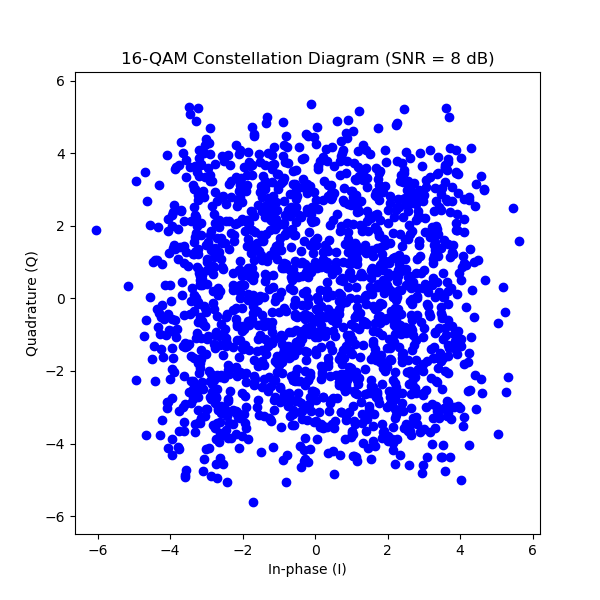
Figure 1: 16QAM Constellation under Low SNR. Noise is high, and all symbols cannot be correctly distinguished.
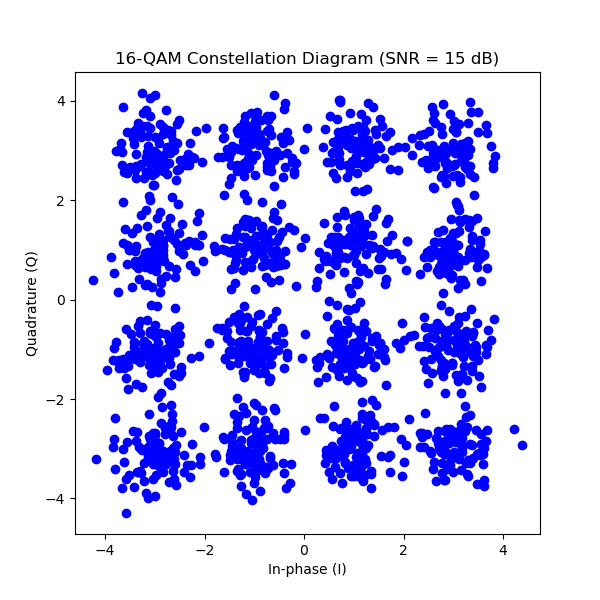
Figure 2: 16QAM Constellation under moderate SNR. Noise is moderate, and all symbols can be correctly distinguishable.
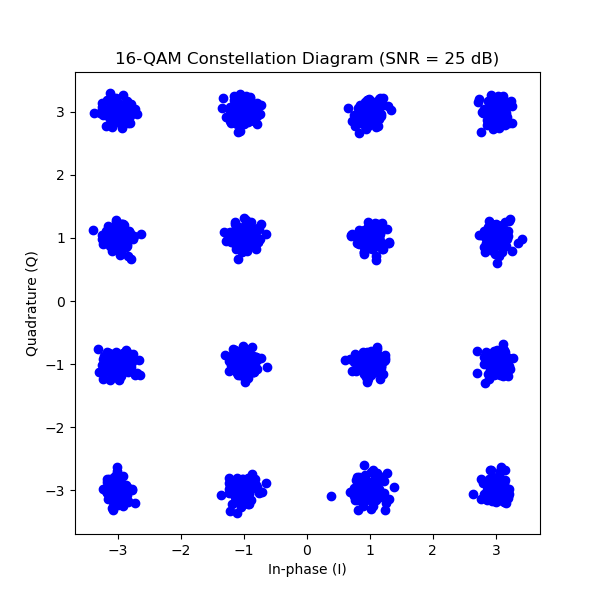
Figure 3: 16QAM Constellation under High SNR. Noise is very less, and all symbols are correctly distinguishable.
High SNR in Real-World Systems
High SNR can be achieved in several ways:
- Line-of-sight (LOS) channels or short-range links reduce path loss.
- High transmit power and directional antennas focus the signal on the receiver.
- Low-noise amplifiers and clean hardware reduce system noise.
With these conditions, higher-order modulation can reliably transmit large amounts of data, such as full-frame video, high-speed wireless links, and fiber-optic communication.
Key Takeaways
- High SNR is essential for reliable higher-order modulation.
- 16QAM and 64QAM can achieve high data rates when channels are clean and noise is low.
- System design techniques like FEC, adaptive modulation, and equalization complement high SNR to minimize bit errors.
- Trade-off - While high SNR enables higher-order modulations, achieving it may require stronger transmit power, LOS conditions, or specialized hardware.